Thermal
Shielding.

Specifically engineered for extreme thermal environments where bioactive integrity is non-negotiable.

Silfeed HC-Bio
Thermal Rating
105°C

Technical
Typical Values.

Oil Absorption (g/100g) ≥ 260
Hydrophobic Angle ≥ 115°
D50 Particle Size (μm) 12.5 ± 2.5
Bulk Density (g/L) 90 - 110
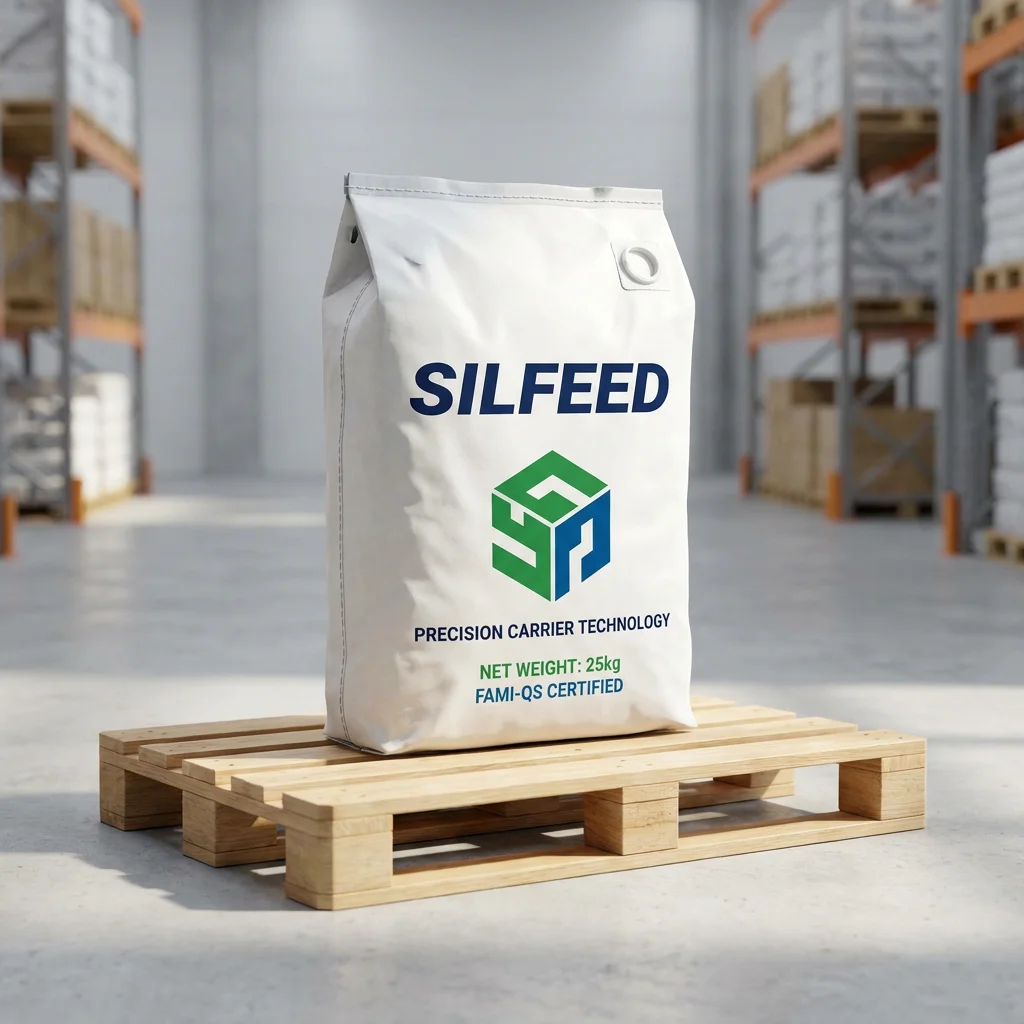
Standard Packaging 25kg / Bag
25kg Bag

Global Shipping Standard

Packed in heavy-duty 25kg multi-layer moisture-shield bags. Optimized for intermodal stability and zero-loss handling.

Net: 25.0 KG Multi-Layer Shield

Performance
Superiority.

95°C Activity Recovery 88% (HC-Bio)
Competitor Average: ~40%
95% RH Flowability Index 92 (HC-Bio)
Competitor Average: ~55

Frequently Asked Questions — HC-Bio

How does HC-Bio protect enzymes during 95°C steam conditioning?

HC-Bio is the only product in the Silfeed HC-Series specifically engineered to protect heat-sensitive bio-active ingredients — enzymes, probiotics, vitamins — during the most severe thermal processing conditions in feed manufacturing. The 95°C steam conditioning stage used in poultry and swine feed pelleting is where traditional carriers catastrophically fail.

The protection mechanism operates through HC-Bio's Hexagonal Mesoporous Shield (HMS) architecture, which is optimized for maximum thermal tortuosity. When steam-conditioning temperatures reach 95°C, untreated silica carriers experience capillary condensation — moisture is forced into the hydrophilic pores, causing the pore structure to collapse and expel the encapsulated active ingredient, resulting in 40–60% loss of enzyme activity.

HC-Bio prevents this through three simultaneous mechanisms. First, the ≥115° contact angle creates an extremely strong hydrophobic barrier. Second, the silane coupling agent bonds are thermally stable well beyond processing temperatures — the covalent Si-O-Si bonds do not break down at 95°C or even at 105°C. Third, the HMS architecture maintains positive Laplace pressure within every pore, actively repelling moisture.

The result is a verified 88% enzyme recovery rate after 95°C extrusion, confirmed by HPLC analysis in technical report T22 (UCSD-MB-2026-T22).

Is HC-Bio suitable for rumen bypass applications in ruminant nutrition?

Yes — HC-Bio is specifically validated and recommended for rumen bypass applications in ruminant nutrition, where the goal is to protect active ingredients (such as choline, methionine, niacin, and specific enzymes) from degradation in the rumen and deliver them intact to the abomasum or lower intestinal tract.

The rumen environment presents a unique challenge: it is a warm (39–41°C), moist, highly microbial fermentation chamber with a near-neutral pH. Active ingredients are often extensively degraded by rumen microbes before they can provide nutritional value.

HC-Bio's ≥115° hydrophobic contact angle creates the moisture barrier needed to prevent premature wetting and dissolution of the active ingredient in the rumen fluid. The HMS architecture's pore tortuosity can be engineered to control the release kinetics — maintaining complete protection throughout the rumen transit time (typically 24–48 hours) and releasing the active in the acidic environment of the abomasum (pH 2–3) or the enzymatic environment of the small intestine.

This targeted delivery capability has direct economic implications for dairy and beef operations. Rumen-protected choline, for example, shows significantly improved bioavailability when delivered past the rumen, supporting liver function in transition cows and improving milk production metrics.

What testing and verification data is available for HC-Bio's thermal performance?

HC-Bio's thermal performance claims are among the most extensively verified in the hydrophobic silica industry, backed by multiple independent testing protocols and third-party validation.

Thermogravimetric Analysis (TGA/DTA):

Testing confirms less than 0.5% mass change at 250°C, demonstrating that the hydrophobic molecular shield does not degrade at temperatures far exceeding normal feed processing conditions.

SEM Surface Mapping:

Hitachi SU8010 Scanning Electron Microscopy confirms 100% pore integrity after 95°C testing — no collapse, no structural deformation, no evidence of moisture penetration.

HPLC Enzyme Recovery Testing:

Technical Report T22 documents high-performance liquid chromatography analysis confirming the 88% recovery rate after 95°C steam conditioning.

Laplace Pressure Verification:

Independent laboratory testing confirms the HMS architecture maintains positive Laplace pressure for water at processing temperatures.

All test data is available to customers upon request, supporting evidence-based procurement decisions and regulatory compliance documentation.

How does HC-Bio compare to other probiotic protection carriers?

HC-Bio offers several distinct advantages over conventional carriers used for probiotic protection, including standard silica, maltodextrin, starch-based matrices, and alginate coating systems.

Thermal resistance:

Probiotic organisms are extremely sensitive to heat, with significant viability loss occurring above 70–80°C in unprotected systems. HC-Bio's ≥115° contact angle and thermally stable silane shield maintain a protective microenvironment around the probiotic cells, significantly improving survival rates through the pelleting process.

Moisture protection:

Probiotics are also highly sensitive to moisture — atmospheric humidity alone can trigger premature germination and subsequent cell death during storage. HC-Bio's hydrophobic barrier prevents moisture ingress throughout the product's shelf life, superior to maltodextrin and starch-based carriers which are themselves hygroscopic.

Process compatibility:

Unlike alginate coating systems that require specialized encapsulation equipment, HC-Bio integrates directly into existing high-shear mixer and microencapsulation systems.

Controlled release:

For ruminant probiotic applications, HC-Bio's pore tortuosity can be engineered for targeted release in the lower intestinal tract, ensuring the probiotic reaches its site of action.
ifically.